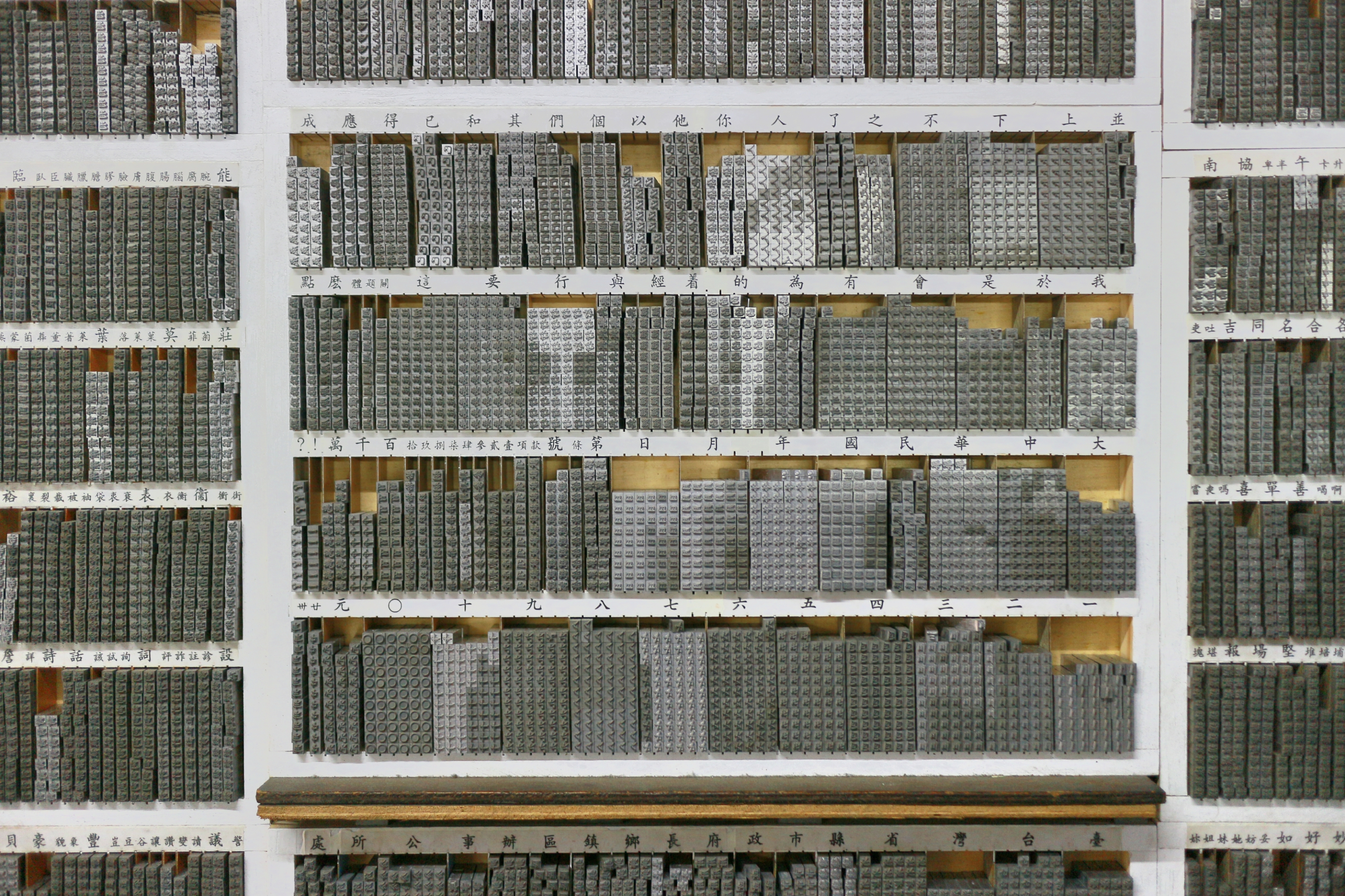






字架的排列方式是按照字典的部首筆劃。由右至左,由上至下。一套字包含常用字與罕用字。日星鑄字行所根據的是出版常用率70%的字為常用字,約兩千個字,而罕用字則會因為字型的大小規格不同而有不同數量。每一家鑄字行的字架排列方式原則上是一樣的,但又會因為每一家鑄字行客戶的不同而有不同的常罕用字。
一般來說,字架製作的時候,會以四的倍數為基準。以五號字作為標準字架,其常用字就是12塊字盤。至於罕用字的部分可能會是28塊至36塊字盤不等。
台灣一般來說分為三種字架,分別為日治時期留下來的日式字架(已很少見或已被改良成台式使用)、上海式字架、台式字架。台式字架較寬、較高,它們是依所有鉛字大小的最小公倍數而設計。日星鑄字行與其他廠商字架最大的不同在於其他廠商都是約略更動日本式字架,在常用字的出張格上另置一盤調格字盤,但日星的字架少了一個調格,因此只有常用字架和一個調格(出張格)和罕用字架而已。而官署常用的字,如:中華民國署局年月日……等,都會列在調格。
國外的字架是抽屜式的,但中文的字架應該要像日星鑄字行一樓的字架一樣一字排開以便於工作,而不能像地下室的字架需要拖拉。以前樓下的字架也和樓上一樣,而且是用檜木製成的。可是後來地下室曾租予他人當作倉庫,只好將檜木字架丟棄,改用這種印刷廠式的字架。字架傾斜度有一定的要求,這樣的角度上下閱讀性較高。一般來說,最下面的那格會特別的傾斜。日治時代的檢字室是木頭地板、木櫃,這樣鉛字落地才不會壞掉。
The arrangement of the typeset shelf is following the radical strokes of the dictionary, from the right to the left; form the top to the bottom, thus, a set of typeface contains commonly used characters and rarely used characters. The commonly used characters in Ri-Xing is based on 70% word frequency of publishing and its around 2,000 character, also the rarely used characters will have different numbers due to different specification of types. In principle, the arrangement of the typeset shelf will be the same in each type of foundry, and according to the different clients, there will have different rarely used characters in each type of foundry.
Generally, when the typeset shelf is made, it will be based on a multiple of four. With size 5 as the standard typeset shelf and the commonly used characters will be 12 of typeset case. Regarding the rarely used characters will be 28 to 36 of typeset cases.
There are three types of typeset cases in Taiwan: Japanese style typeset shelf that is rarely to seem and be improved to Taiwanese style; Shanghai style and Taiwanese style. The Taiwanese style typeset shelves are wider and taller than another style also they are designed according to the least common multiple of typeset size. The biggest difference between Ri-Xing and other type foundry is that another type foundry has slightly modified form Japanese style typeset cases, and there will quip additional adjusting-typeset cases along with the “しゅっちょう”(SHUCCHOU) cases of commonly used characters. Thus, Ri-Xing has a commonly-used typeset case, adjusting-typeset cases, and rarely used typeset cases only. The official type which is commonly used character will be in this adjusting-typeset cases, such as “CHONG”, “HUA”, “MIN”, “GUO”, “bureau”, “administration”, “year”, “month”, “day”.
Foreign typeset cases are drawer-type, but the typeset cases of Chinese character have to be lined up like the typeset cases on the first floor in Ri-Xing type foundry to facilitate work, also it cannot be dragged like the one in the basement. The typeset cases downstairs used to be the same as upstairs, and it was made of cypress. However, the basement was leased to another as a warehouse, so the cypress-typeset cases were discarded and replaced with the typeset cases of the printing factory. There are certain requirements for the inclination of the typeset cases, and this kind of angle has a better reading ability. Generally, the bottom grid will be particularly inclined. In the Japanese colonial period, the typeset-indexing room was made of wooden, such as wooden floors and wooden cabinets, so that the type wouldn’t be damaged while it dropped.