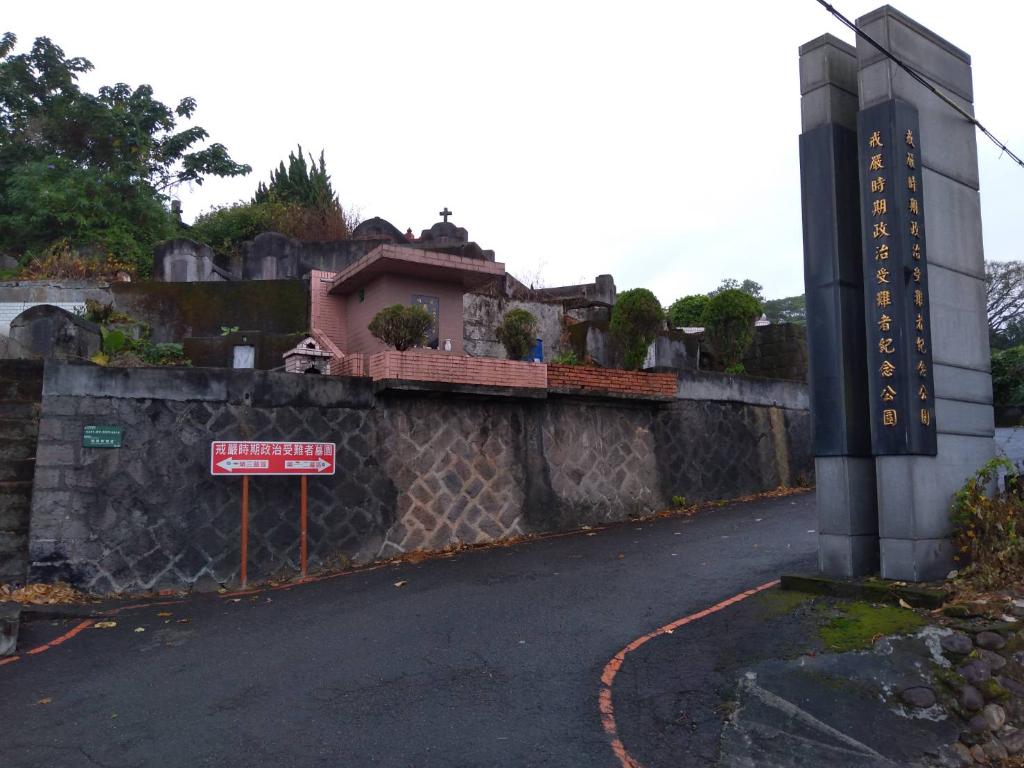








An “Elysium” for deceased political prisoners: the Elysium Public Cemetery of the Elysium Funeral Home
The Liuzhangli cemeteries are located among the hills at Chongde Street, Liuzhangli, Xinyi District, Taipei City (currently known as the Taipei Municipal Cemetery and the Cemetery for the Victims of Political Persecution during the Martial Law Period), now under the management of the Taipei City Mortuary Services Office. There are about 200 graves and tombstones in the cemetery, most of which belong to victims from the 1950s of the White Terror whose bodies have not been claimed. Owing to a search conducted by survivor Zeng Meilan for his brother Xu Qinglan's body, the cemeteries became public knowledge in 1993.
This area was named Liuzhangli Village after a restructuring of the municipal system in 1920 during the period of Japanese rule. It was so named because the Qing government had reclaimed 30 jia of land, with 5 jia making up 1 zhangli; hence, the name Liuzhangli (6 zhangli) was derived. During the rule of Emperor Daoguang in the Qing period, Chongde Street was the main mountain road for tea farmers from Shiding and Shenkeng to travel on as they carried their produce from the mountainous areas of Muzha and traversed the hilly terrain to arrive at Bangka, where the goods would be loaded onto ships for export. Hence, Chongde Street was also referred to as the “Tea Road.” It was later renamed “Liuzhangli Road,” before coming to be known as “Chongde Street” in 1978.
After the war, in 1949, then-Taipei City mayor of Taipei Yu Mi-chien pushed for public funeral halls to be re-established as funeral homes. He invited Qian Zongfan, former chairman of the Shanghai Funeral Trade Association, to run the establishment. The Japanese-era Sanbanqiao Funeral Hall, along with its affiliated Liuzhangli Public Cemetery, an area of more than ten hectares in total, came under the management of Qian Zongfan. Subsequently, Qian changed the name of the hall and the graveyard to “Elysium Funeral Home” and “Elysium Public Cemetery.”
In the 1950s, notices would be put up at Taipei Main Station to inform family members of the executed political detainees to claim the bodies within three days. All of the bodies went through the Elysium Funeral Home, where they were soaked in formalin for preservation. Family members of the deceased had to pay a considerable amount of money as a “body retrieval fee” and a “bullet fee” before they could retrieve the bodies. During the harsh regime of the White Terror, many families were too impoverished to pay the body retrieval fee or they were afraid that claiming the bodies would cause them to be implicated, while others were not even aware that their loved ones had been executed; furthermore, there were victims from Mainland China that did not have any family members in Taiwan. As a result, many bodies remained unclaimed.
Some of the unclaimed bodies were sent to the National Defense Medical Center, where they were used in dissection lessons and then cremated or buried. The rest of the bodies were buried in the Elysium Public Cemetery (the Liuzhangli cemeteries) by the Elysium Funeral Home. The dual factors of a society that did not value human rights and a management that lacked organization, resulted in most of these bodies being dealt with in a haphazard manner, creating mass graves and columbaria for the political victims that no one took care of.
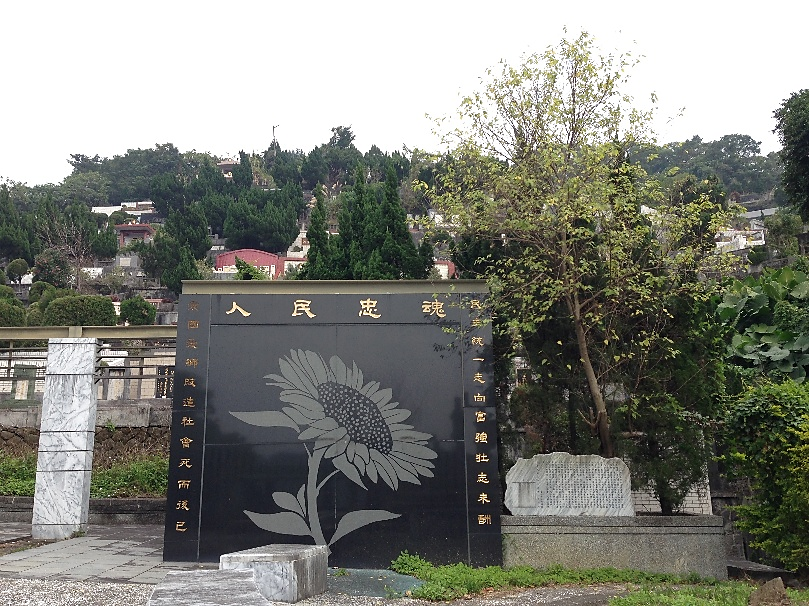
▲ Memorial plaque at the Liuzhangli cemeteries. (Source: National Human Rights Museum)
The Liuzhangli mass graves, where one has to step over the bodies of the victims to move forward
On May 28, 1993, the White Terror victim Zeng Meilan conducted a search for the body of his brother Xu Qinglan (executed by firing squad on August 8, 1952). With the help of a tugong (someone specialized in gathering the bones of victims to return to their families) by the name of Ah Bin, Zeng Meilan located the grave of Xu Qinglan among the bamboo groves in the Liuzhangli cemeteries. His search also revealed the more than 200 mass graves hidden among the bamboo and weed, as well as a columbarium resembling an abandoned warehouse. The grave of Huang Rong-can, renowned woodcut printmaker, was also located in this cemetery.
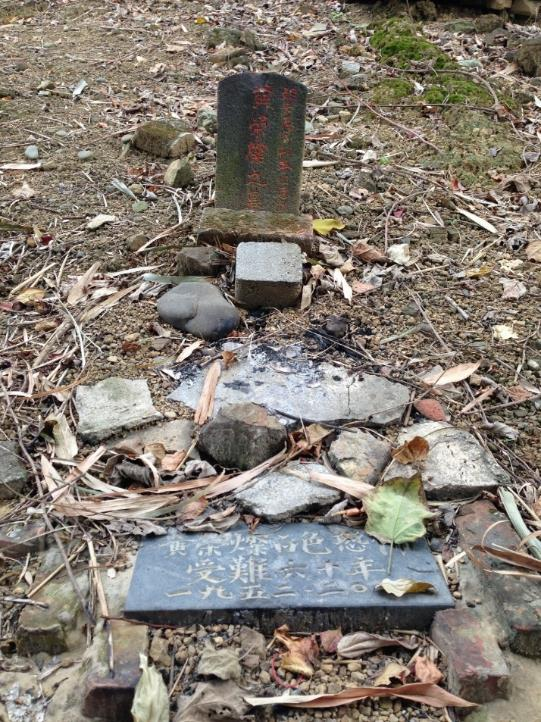
▲ The grave of renowned woodcut printmaker Huang Rong-can can be found in Section 1 of the Liuzhangli cemeteries. (Source: National Human Rights Museum)
The Cemetery for the Victims of Political Persecution during the Martial Law Period is divided into four sections (three hillside burial grounds and one columbarium). According to findings of the “Investigation Plan of Liuzhangli Historical Sites from the White Terror Period,” there are about 365 people buried in the cemetery. After verification against a list of names, it was determined that 264 of these graves belong to victims of the White Terror, while the remaining 101 are the graves of ordinary citizens. The conditions of the burials and number of graves give us an indication of the distribution of various persecuted groups at the height of the White Terror: among the 264 graves, there are only 8 women; about 60% of the graves belong to victims from Mainland China, and 70% belong to young people below the age of 35. Most of the people buried here were sentenced to death between 1950 and 1953 by the Military Law Office of the Taiwan Provincial Security Command and the Military Law Bureau of the Ministry of National Defense.
The Liuzhangli cemeteries are now known as the “Taipei Municipal Cemetery.” The “Memorial Park for the Victims of Political Persecution during the Martial Law Period” was established in 2003, complete with a commemorative column. In addition, the “Taiwan Association for the Care of the Victims of Political Persecution” has been helping family members of the deceased in finding and claiming the bodies, which are now under the charge of the Taipei City Mortuary Services Office. Today, even though the Liuzhangli Public Cemetery has been designated as a memorial park for political victims, there is still a lot more to be done on the site. There is only one footpath leading to the cemetery, so if a visitor wishes to take a closer look at a particular tombstone, he or she has to step over the body of a deceased victim. This is a reminder that, even as we move forward in time, we are stepping on a history that should never be forgotten.
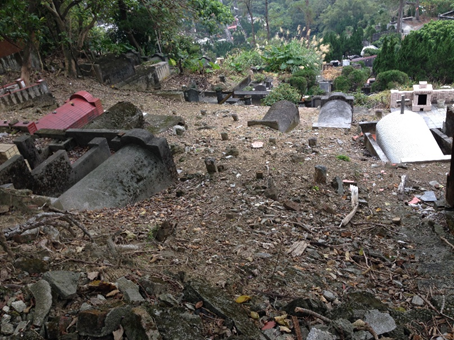
▲ Looking down on Section 2 of the Liuzhangli cemeteries. (Source: National Human Rights Museum)