






From execution grounds to public cemetery: Ankeng Execution Grounds, only one hill away from Xindian Military Prison
Ankeng Execution Grounds, affiliated with the Ministry of National Defense, was situated on today’s Anhua Road, Xindian District, New Taipei City (the former “execution grounds road”), its date of establishment and abolition unknown. The execution grounds mainly served to execute political prisoners in the 1950s during the White Terror period, and were established to replace the Machangding Execution Grounds.
More research is required to determine the time of establishment and abolition and the exact address of the Ankeng Execution Grounds. The execution grounds had started to be used in 1954 at the latest (four defendants and Li Yuwen of the 87th Infantry Division in the Duan Yun Case were executed on the execution grounds on January 30 of that year), and there are records of executions up to 1989 (military police officer Hong Yanjin of Zhitan Company). The original site is now the Xindian District Third Public Cemetery, making the scope and area of the former execution grounds difficult to determine. The execution grounds and Taiwan Military Prison of the Ministry of National Defense (also known as Xindian Military Prison, now Sindian Drug Abuser Treatment Center) were both located in the mountains of Ankeng, separated by only one hill. It was close to Xindian River, and was one of the execution grounds along Xindian River in the 1950s along with the Machangding and Bitan Execution Grounds.
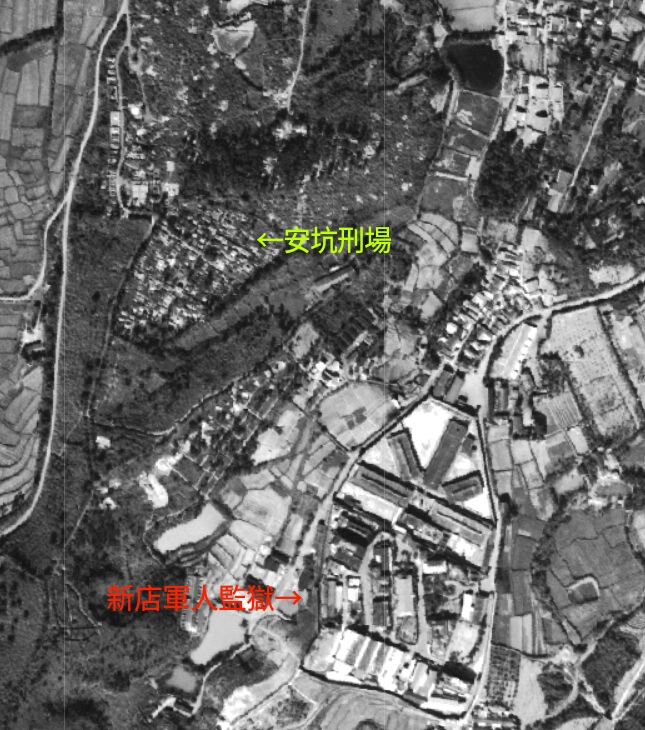
▲ Aerial photograph of the Ankeng Execution Grounds. (Source: Center for GIS, RCHSS, Academia Sinica (2018). “Taiwan Historical Maps in the Last One Hundred Years.” Available at: http://gissrv4.sinica.edu.tw/gis/twhgis/)
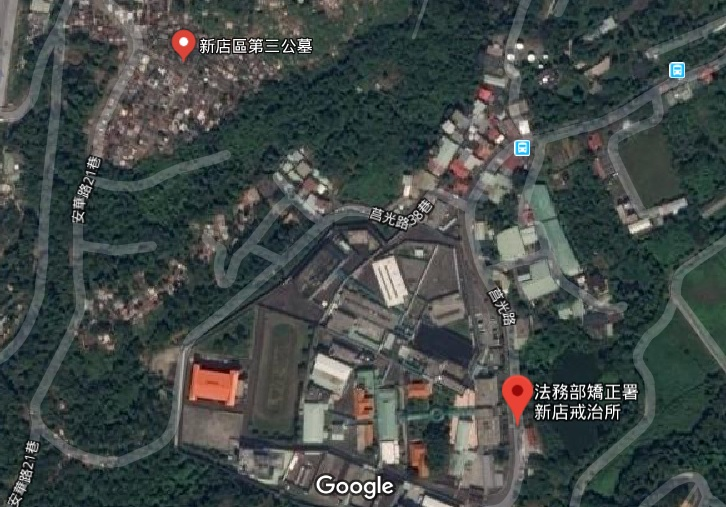
▲ The Ankeng Execution Grounds (now the Xindian District Third Public Cemetery) and Xindian Military Prison (now Sindian Drug Abuser Treatment Center, Agency of Corrections, Ministry of Justice) were separated by only one hill. (Source: Google Maps ©2018 Google)
Blood-soaked Xindian River: from the Machangding Execution Grounds to the Ankeng Execution Grounds
In the 1950s during the White Terror, a great number of “political prisoners” were arrested, the number greatly exceeding the capacity of prisons and detention centers. In order to accommodate the vast number of victims arrested, many additional detention center branches and military prisons were set up, and prisoners, after being tried and sentenced to death, would be executed at the execution grounds right away. During the early White Terror period, execution grounds were set up along the banks of Xindian River: Machangding, along Shuiyuan Road on the same side as Machangding, and on the south end across Chuanduan Bridge (now Zhongzheng Bridge) near Yonghe. In 1952, after the construction of the Xindian Military Prison was completed, execution grounds were set up right next to the prison in Ankeng. After opening for use in 1954, the Ankeng Execution Grounds immediately replaced the Machangding Execution Grounds as the main execution grounds for political prisoners.
According to official records, political prisoners executed at the Ankeng Execution Grounds included Tang Shou-jen, Kao Yi-sheng, and Lin Rigao involved in political cases related to indigenous people, Chiang Ping-hsing, Cheng Chin-ho, Chan Tien-tseng, Chen Liang and Hsieh Tung-jung involved in the Taiyuan Incident, and many figures promoting Taiwan independence. The military force carrying out the executions were no longer the 4th and 8th Regiments of the Military Police from the Machangding and Shuiyuan Road period, but the Taipei Military Police and 201th, 202nd and 203rd Regiments of the Military Police.
The number of political prisoners executed on the Ankeng Execution Grounds was second to only Machangding. The execution grounds were the second largest execution grounds during the White Terror period in Taiwan. The Ankeng Execution Grounds were established for over 30 years until around 1988 when judicial prisons replaced its function. Compared with the Machangding Execution Grounds which were only established for four years, if non-political criminals executed on the Ankeng Execution Grounds were included, then the number of people who perished there would not be less than on Machangding.
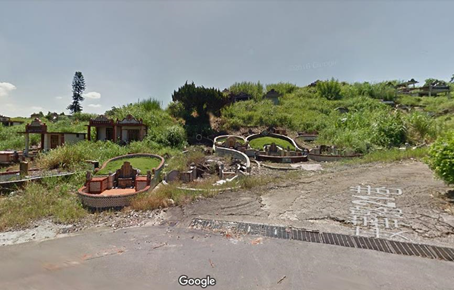
▲ The original site of Ankeng Execution Grounds, now the Xindian District Third Public Cemetery. (Source: July 2016 ©2018 Google)