






The “Xin cell block” of Xindian Military Prison: Ankeng Detention Center
The Ankeng Branch of the Detention Center of the Military Law Office under the Taiwan Garrison Command, also called Ankeng Detention Center, was originally under the jurisdiction of the Taiwan Provincial Security Command, which was reorganized into the Taiwan Garrison Command in 1958. It is not clear when the branch was established and disbanded (roughly in the middle of the 1950s after the establishment of the Xindian Military Prison in 1952). Because the number of holding cells in the Detention Center of the Military Law Office on Qingdao East Road was not sufficient, the “Xin cell block,” one of the five prison cell buildings of the Taiwan Military Prison of the Ministry of National Defense in Xindian (called Xindian Military Prison for short), was appropriated to be the Ankeng Branch. Located at today’s No. 42, Juguang Road, Xindian District, New Taipei City, it was mainly used as substitute prison for political prisoners from the 1950s to 1970s.
As stated in the November 22, 1967, file “Relocation Plan of the Detention Center of the Military Law Office of the Taiwan Garrison Command” from the Military Law Office Relocation Program: “The center is required to be temporarily relocated from Qingdao East Road, Taipei City to the Ankang Branch within the allotted time (before December 24, 1967); after the new construction has been completed, it must again move from the Ankeng Branch to the Jingmei camp. During this period, continue incarcerating prisoners and enforcing sentences.” This shows that before the completion of Jingmei Detention Center in Xindian (now the Jing-Mei White Terror Memorial Park), the Detention Center on Qingdao East Road was temporarily transferring most of its prisoners to the Ankeng Branch from December 1967 to June 1968, making it seem as though as if the was the temporary head office of the Detention Center of the Military Law Office.
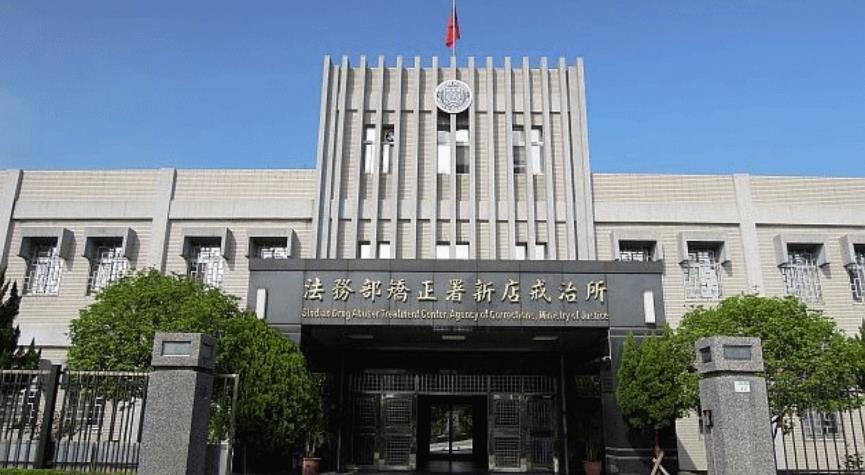
▲ Ankeng Detention Center was formerly established in the “Xin cell block” of the Xindian Military Prison, which was later converted into the Sindian Drug Abuser Treatment Center of the Agency of Corrections under the Ministry of Justice. (Source: The site of Sindian Drug Abuser Treatment Center, Agency of Corrections, Ministry of Justice)
Incarcerated politically, e xploited economically
According to victims, they were required to engage in various kinds of labor during their detention; not only were they incarcerated politically, but their labor power was also exploited economically. The Detention Center on Qingdao East Road was equipped with factories for laundry, sewing, ironing and handicrafts that could be operated within the center. Meanwhile, Ankeng Branch set up production groups for heavy labor such as large-area land cultivation, pig raising and sand extraction. This reveals that the detention center required prisoners to engage in outside prison labor under the name of serving in a “substitute prison.” As for the transitional period of the relocation from Qingdao East Road to Jingmei, apart from the handicraft factory, the center even merged the laundry and sewing factories into the Ankeng Branch, which had almost become an “open prison labor special zone” or a “production base” of the main center, bringing “non-operating income” to the detention center.
The blue sky outside the window
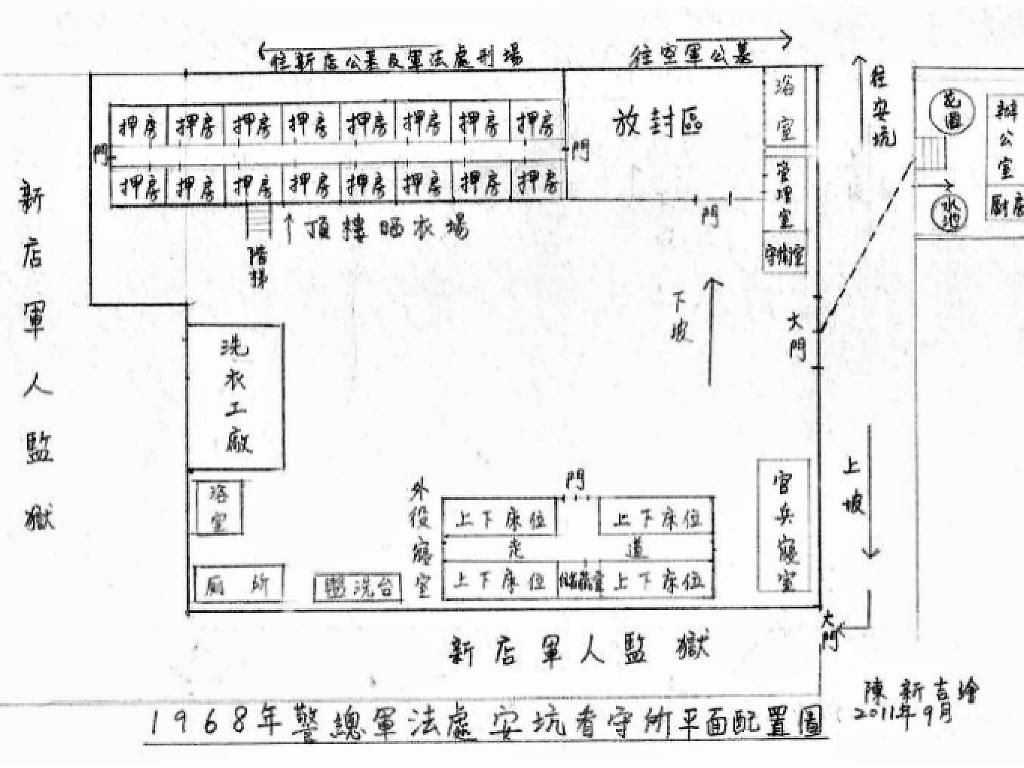
Of the five prison cell buildings of Xindian Military Prison named “Ren,” “Yi,” “Li,” “Zhi” and “Xin,” the Xin cell block which Ankeng Detention Center borrowed was nearest to the main roads, with its entrance set next to the gate of the Military Prison. According to the description of Hsieh Tsung-min, in the center of the branch (Xin cell block) building there was a corridor, with holding cells on the two sides. Inside the holding cells, prisoners could only sleep on floors; there was a one-meter concrete floor in front of the back wall, with the latrine pit on one side, and a tap water tank on the other. On the back wall was a small window with an iron grill measuring 20 centimeters, through which the prisoners could see the faraway sky when standing on the floor. Chen Hsin-chi described the outside prison labor dormitories, saying that if you used a ladder to climb up the roof of the cell, you would be at the yard for drying clothes. From there, you could see the prisoners in the building next door being let out.
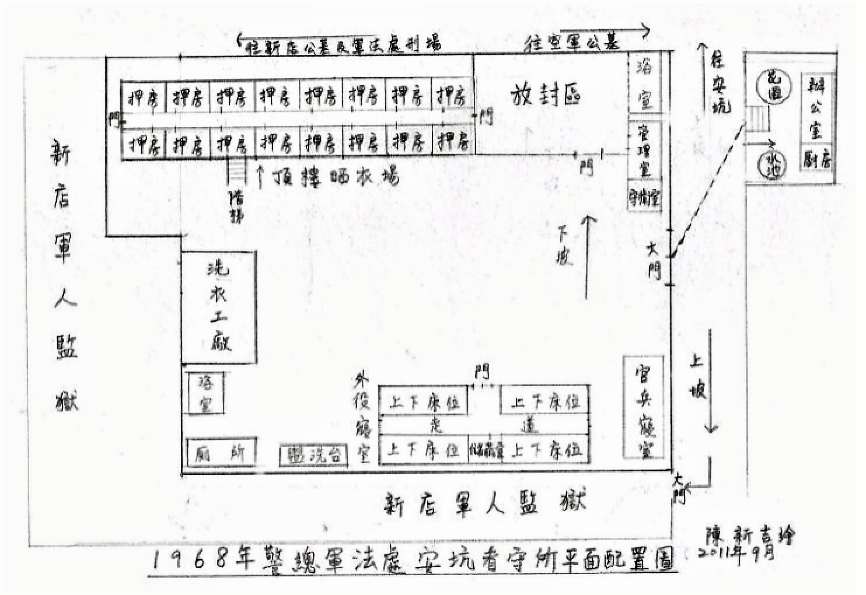
▲ Floor plan of Ankeng Detention Center of the Military Law Office under the Taiwan Garrison Command in 1968, drawn by Chen Hsin-chi. (Source: Chen Hsin-chi/National Human Rights Museum’s concluding report “Taiwan, Island of Prisons.”)
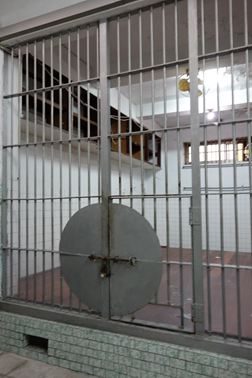
▲ “Xin cell block” (now renamed “Zhong Prison”) was closest to the outside roads in Xindian Military Prison, and was used by the Ankeng Branch of the Military Law Office of the Taiwan Provincial Security Command during the Military Prison period. (Source: Transitional Justice Commission, Executive Yuan)