







The Taipei Military Prison of the Ministry of National Defense was established in 1947. Its previous location was somewhere in the block to the south of Section 1, Zhongxiao East Road, to the west of Linsen South Road, to the north of Qingdao East Road and to the east of Zhenjiang Street, but its exact location has yet to be verified. It was the first military prison in Taiwan after World War II, and was near the Detention Center of the Military Law Office under the Taiwan Provincial Security Command (today’s No. 3, Qingdao East Road) and the Detention Center of the Military Law Bureau under the Ministry of National Defense (today’s No. 1, Qingdao East Road). The three buildings were transformed from Japanese-period army warehouses.
The Taipei Military Prison’s old site on Qingdao East Road had one cell block for female prisoners and four other cell blocks labeled “Zi,” “Xin,” “Gai” and “Guo” respectively. Each cell block had seven cells. Since the military prison was too close to adjacent prisons and became overcrowded, it was relocated to Ankeng in New Taipei City (currently No. 42, Juguang Road, Xindian District, New Taipei City) in March 1952. Its name was changed to the Taiwan Military Prison of the Ministry of National Defense (also called Xindian Military Prison), to distinguish it from when it was on Qingdao East Road.
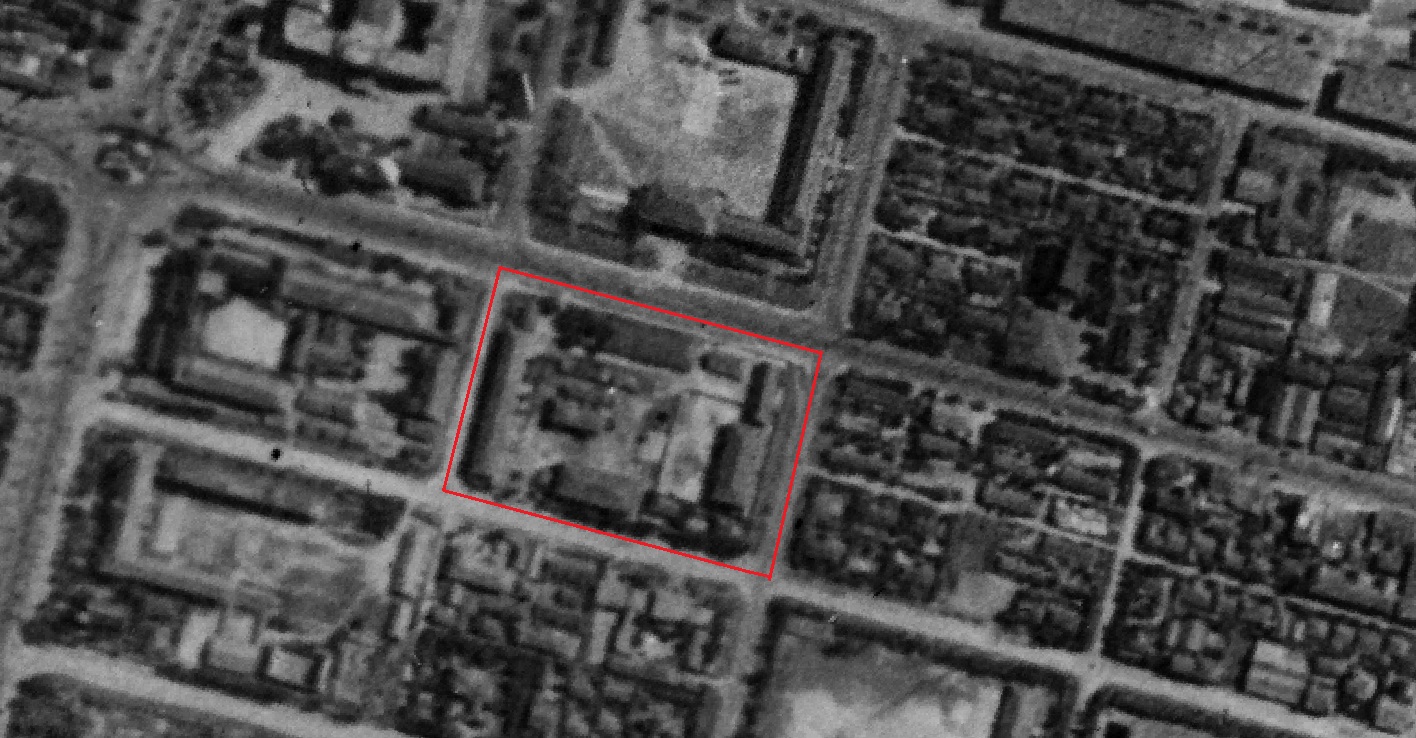 ▲ A 1948 aerial image from the US Military. The red square marks the block where the military prison was located. (Source: Center for GIS, RCHSS, Academia Sinica (2018). “Taiwan Historical Maps in the Last One Hundred Years.” Available at: http://gissrv4.sinica.edu.tw/gis/twhgis/ ; frame lines added.)
 ▲ The “Index” of the Taipei City Map printed in March 1952 marked the military prison as No. 53. (Source: Center for GIS, RCHSS, Academia Sinica (2018). “Taiwan Historical Maps in the Last One Hundred Years.” Available at: http://gissrv4.sinica.edu.tw/gis/twhgis/)
The prison was overcrowded and foul, prisoners were ill
The military prison was only located on Qingdao East Road for a short period of time, and since political prisoners were only there to be “rinsed” (temporarily detained before being transferred to other prisons), few records or descriptions were made. The condition in the military prison could roughly be inferred from Chiang Ching-kuo’s inspection reports as well as victim Li Zhenzhou’s description in his memoir First Freshmen on the Island of Fire.
In October 1950, Chiang Ching-kuo, then-Director of the General Political Department under the Ministry of National Defense, went all around Taiwan to inspect military prisons. On 15 December 1950, he published the Inspection Report of Military Prisons and Detention Centers of Various Units. In “Inspection Account of Military Prisons and Detention Centers in Taiwan,” he mentioned that the Taipei Military Prison at that time had four cell blocks and imprisoned more than 900 inmates: “It is very crowded; the air quality is poor; the rooms smell terrible and lack natural lighting.” Furthermore, the amount and kinds of medical supplies in this prison were insufficient: “Every month there are many who contract tuberculosis, dysentery and beriberi. There are currently more than 40 prisoners who are gravely ill, and more than 200 with common illnesses.” With an estimated one-in-four prisoners having falling ill, the poor quality of the environment is clear.
Li Zhenzhou, imprisoned from July 1950 to April 1951 in the Taipei Military Prison, described the prison environment in his memoir First Freshmen on the Island of Fire: the cells were small and crowded, apart from lack of ventilation and bad odors, prisoners could only sleep on one side due to scarcity of space. One tatami mat was shared by four prisoners. Prisoners didn’t dare leave their place to go to the bathroom in the middle of the night because others would take their sleeping space. Food offered in the prison was merely soup with bean sprouts. Prisoners thus suffered from malnutrition and edema in their stomachs. They might also contract rheumatism or arthritis. The only thing prisoners enjoyed were a partial freedom of speech and a freedom to sing, and thus they managed to have some sort of knowledge-exchange during their time in prison.
The structures of the Taipei Military Prison on Qingdao East road have all been demolished, not one trace remaining. On the block now stand the Taipei Sheraton Grand Hotel and other office buildings.