







The Criminal Investigation Corps in the Japanese and postwar eras
The Detention Center of the Criminal Investigation Corps under the Taiwan Provincial Police Division, relocated in 1933 to Hōrai-chō (or Penglai District, at the present intersection of Ninxia Road and Jinxi Street in Datong District, Taipei City), was under the purview of the Taihoku North Police Agency. In those days the Taihoku Police Agency was comprised of the Taihoku South Police Agency (or South Agency, located within Old Taipei) and the Taihoku North Police Agency (or North Agency, located within Dadaocheng District). Under the purview of the North Agency, the Criminal Investigation Corps was situated at the same address as the detention center.
After World War II, the North Agency was taken over by the Police Division of the Taiwan Provincial Administration Office, with its jurisdiction transferred to the Taipei City Government. In 1945, the venue of the North Agency was converted to the office building of the First Precinct of the Taipei City Police Department. In 1949, the Criminal Investigation Corps was established here under the purview of the Taiwan Provincial Police Division, of which the Political Section was in charge of political surveillance. In 1958, the Criminal Investigation Corps was reorganized into the Criminal Investigation Brigade.
According to the amendments to Organization Regulations of the Criminal Investigation Corps of the Taiwan Provincial Police Division promulgated on September 5, 1952, the number of the enlisted personnel was between 232 and 245. The Criminal Investigation Corps, among Taiwan’s numerous intelligence agencies, belonged to the “police system,” which was supposed to differ from “intelligence system” bodies like the Secrets Bureau, the Taiwan Provincial Security Command and the Taiwan Garrison Command. However, most members of the Criminal Investigation Corps enjoyed a double identity within the Secrets Bureau, which shows police and intelligence were not separated at that time.
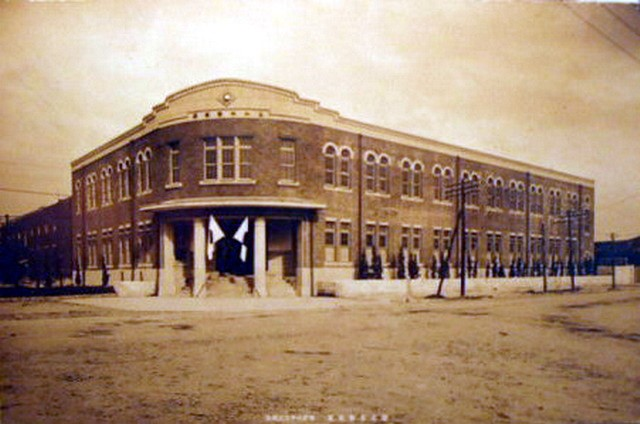
▲ Taipei North Police Agency under Japanese rule. (Source: National Taiwan Library)
From the Criminal Investigation Corps to the Taiwan New Cultural Movement Memorial Museum
In 1973, the Criminal Investigation Bureau of the National Police Agency was established and officially integrated with the Criminal Investigation Brigade. In 1984, the Criminal Investigation Bureau was moved out and the First Precinct of the Taipei City Police Department (Datong Precinct) was moved back in. In 1985, due to an organizational makeover of Taipei City police stations, the original Datong, Yanping and Jiancheng Precincts were merged into Ningxia Precinct (or First Precinct), whose name was changed back to Datong Precinct in 1990 as a result of the administrative restructuring of Taipei City.
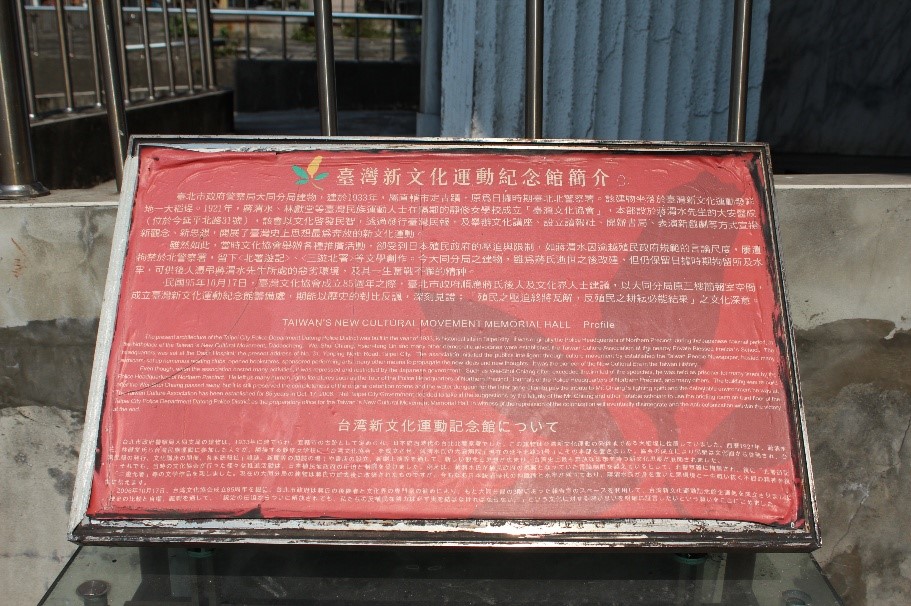
▲ Introduction plaque of the Taiwan New Cultural Movement Memorial Museum. (Source: National Human Rights Museum)
This building was designated as a municipal historic site in 1998. In 2012, after the Datong Precinct was moved out, it became the preparatory office for the “Taiwan New Cultural Movement Memorial Museum.” In 2016, the restoration and repair began with the demolition of the third floor that was built after the war. The construction of the museum was completed on October 14, 2018, and is currently run by the Department of Cultural Affairs of the Taipei City Government.
The wooden building and the wall stones of Old Taipei
The wooden structure of the building from the period of Japanese rule was replaced by a concrete structure in 1933. The renewed building used the stones of the Old Taipei city wall that was demolished in 1900 as its construction materials. Relics of the Old Taipei city wall have been preserved. The building’s original appearance remains intact, but the surface of the facade and two sides of the building were covered with new tiles, while the original umber-colored brick tiles (produced by the Beitou Kiln) of the building’s back side were preserved.
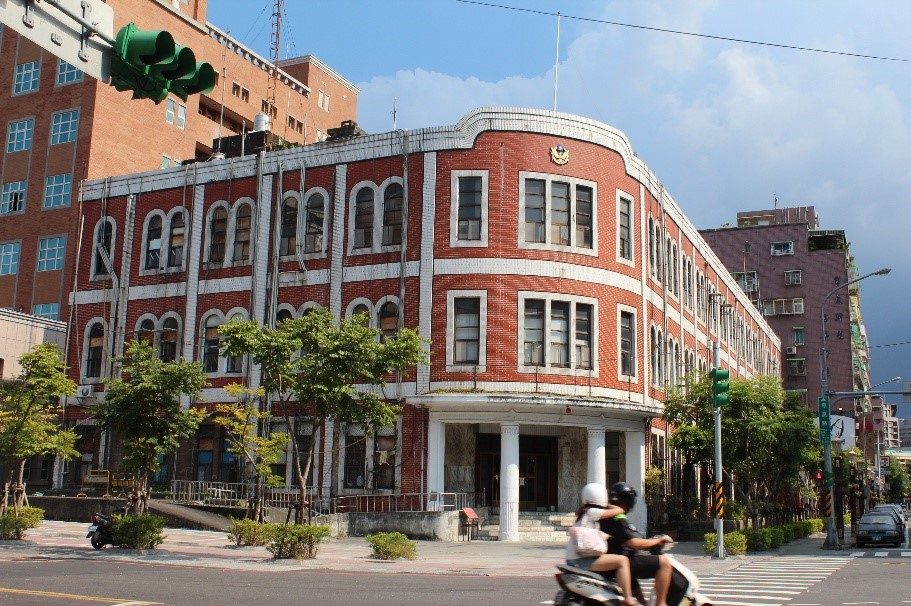
▲ The original appearance of the facade and two sides of the Detention Center of the Criminal Investigation Corps prior to its restoration and repair in 2015. (Source: National Human Rights Museum)
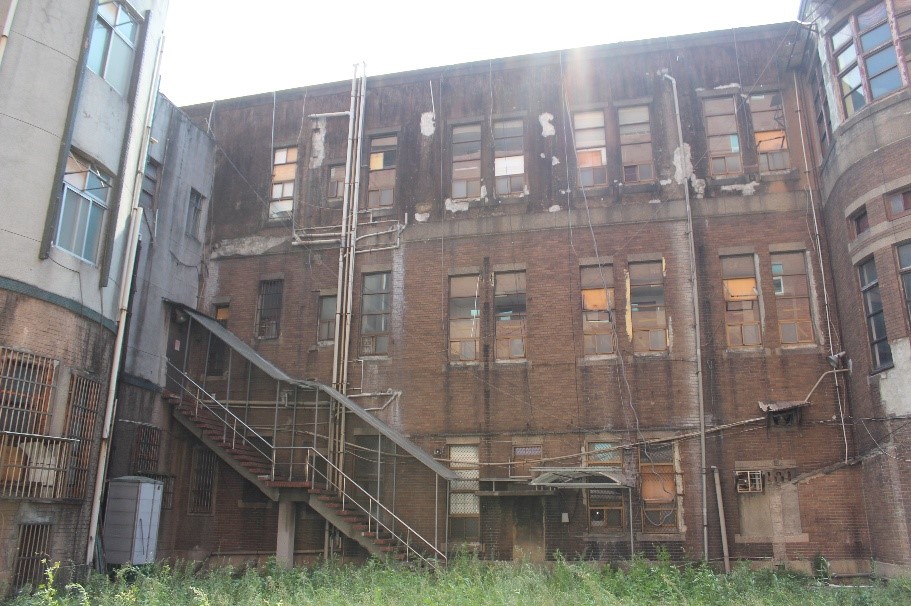
▲ The original appearance of the back side of the Detention Center of the Criminal Investigation Corps prior to its restoration and repair in 2015. (Source: National Human Rights Museum)
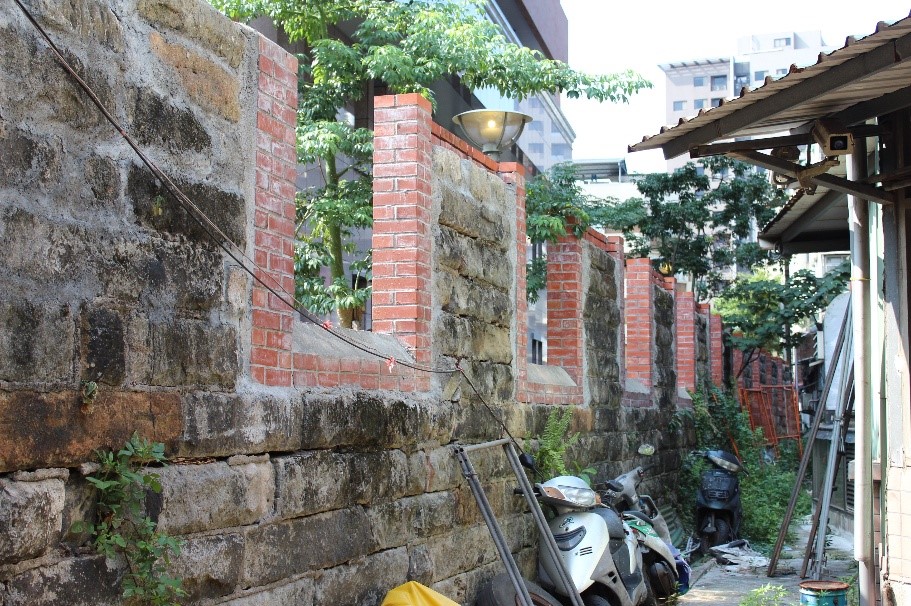
▲ Wall remnants of the Detention Center of the Criminal Investigation Corps prior to its restoration and repair in 2015 (photo taken at Alley 2, Lane 97, Guisui Street). One can clearly see the stones of the Old Taipei city wall. (Source: National Human Rights Museum)
Submerged to the neck in the water dungeon
Between 1949 to 1958, this building was used as a prison for confining political prisoners during the White Terror period. Prisoners were temporarily detained here and transferred elsewhere afterwards. In order to easily monitor the inmates, the seven detention rooms, lodging room and two interrogation rooms were arranged in a circle. On the other side was a narrow, underground “water dungeon” which covered a space of about three square meters. Water would be poured into the dungeon until it reached the prisoner’s neck, immobilizing their limbs. The remnants of the water dungeon prove the practice of torture in this prison.
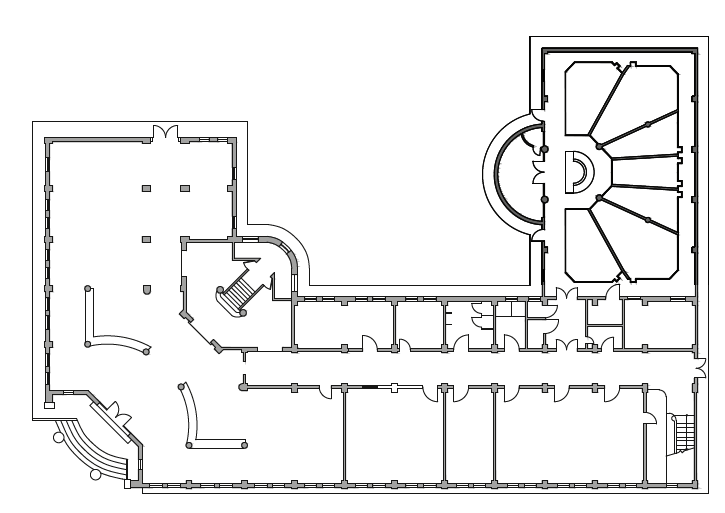
▲ The original appearance of the circularly-arranged detention rooms inside the Detention Center of the Criminal Investigation Corps. (Source: National Human Rights Museum)